
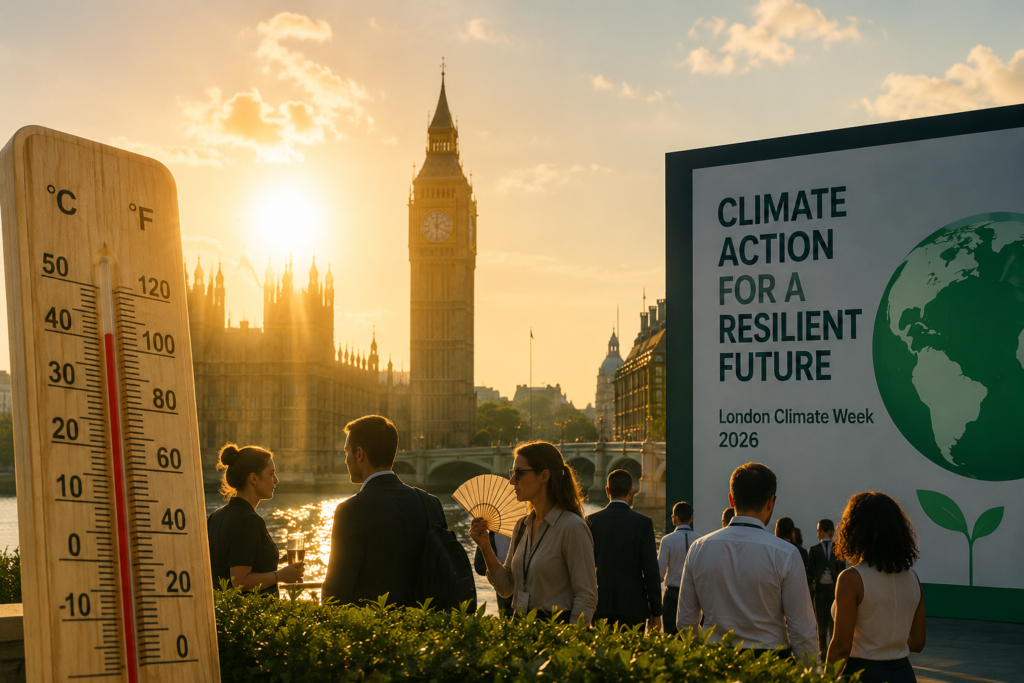
Climate conversations often happen through reports, targets, and future projections. This week in London, those conversations unfolded under conditions that reminded participants that climate change is already influencing daily life.
As one of the world’s major sustainability gatherings brought together policymakers, business leaders, investors, and climate experts, unusually high temperatures across the city became impossible to ignore. What was expected to be a week of strategy and collaboration also became a direct example of the challenges many communities may face more frequently in the years ahead.
When Climate Discussions Meet Climate Reality
London’s climate events attracted thousands of participants from across sectors, all focused on accelerating progress toward climate goals and preparing for upcoming international discussions.
However, the city’s heat created conditions that affected normal activities. In one case, concerns around indoor temperatures and attendee safety led to the cancellation of a planned session focused on heat resilience.
The situation reflected an important point that many experts have been raising for years. Climate risks are no longer theoretical scenarios. They are becoming visible in workplaces, public spaces, infrastructure systems, and economic planning.
Why Heat Resilience Is Becoming a Global Priority
Throughout the event, one message remained consistent: adaptation can no longer be treated as a secondary climate strategy.
Speakers highlighted that rising temperatures are creating challenges that extend beyond comfort. Heat can influence public health, increase pressure on infrastructure, affect productivity, and create economic uncertainty.
Cities around the world are being asked to rethink how they prepare for more frequent periods of extreme weather. Buildings, transport systems, water management, and emergency planning are increasingly becoming part of climate discussions.
Climate resilience emerged as one of the strongest themes across multiple sessions.
Investment and Policy Are Moving Into Focus
Experts and global leaders emphasized that long term investment decisions will play a major role in determining how societies respond to climate challenges.
Key areas receiving attention included:
- Building stronger and more climate ready infrastructure
- Supporting communities facing higher environmental risks
- Expanding climate adaptation funding
- Encouraging stronger public policy and implementation
Participants also discussed how businesses can improve operational resilience while reducing environmental impact across supply chains.
Industries such as agriculture continue to receive attention as organizations explore ways to improve resource efficiency and lower emissions.
The Cost of Delayed Action
Recent climate and public health research continues to point toward growing concerns around heat related impacts.
Without stronger preparation and faster emissions reduction efforts, experts warn that prolonged heat events could place increasing strain on health systems, economic performance, and local communities.
For many attendees, the experience in London reinforced a broader shift in perspective.
Climate change is increasingly being viewed not only as an environmental issue but also as an operational, social, and economic challenge that requires immediate action and practical solutions.
Final Thoughts
The events in London served as more than another climate gathering.
They became a reminder that environmental change is beginning to shape everyday experiences in ways that are visible, measurable, and difficult to overlook.
As governments, businesses, and communities prepare for the next phase of climate action, resilience and adaptation are likely to become central priorities rather than future ambitions.
