
Climate change has become one of the most pressing global challenges, and the responsibility to address it is often placed on industries and energy sectors. While these areas play a major role, agriculture is now gaining recognition as a powerful part of the solution. A concept known as carbon farming is changing how we view farming by turning agricultural land into a tool for climate restoration.
What is Carbon Farming?
Carbon farming refers to a range of agricultural practices designed to capture and store carbon in soil, vegetation, and organic matter. Instead of focusing only on crop production, this approach encourages farmers to actively reduce carbon dioxide levels in the atmosphere.
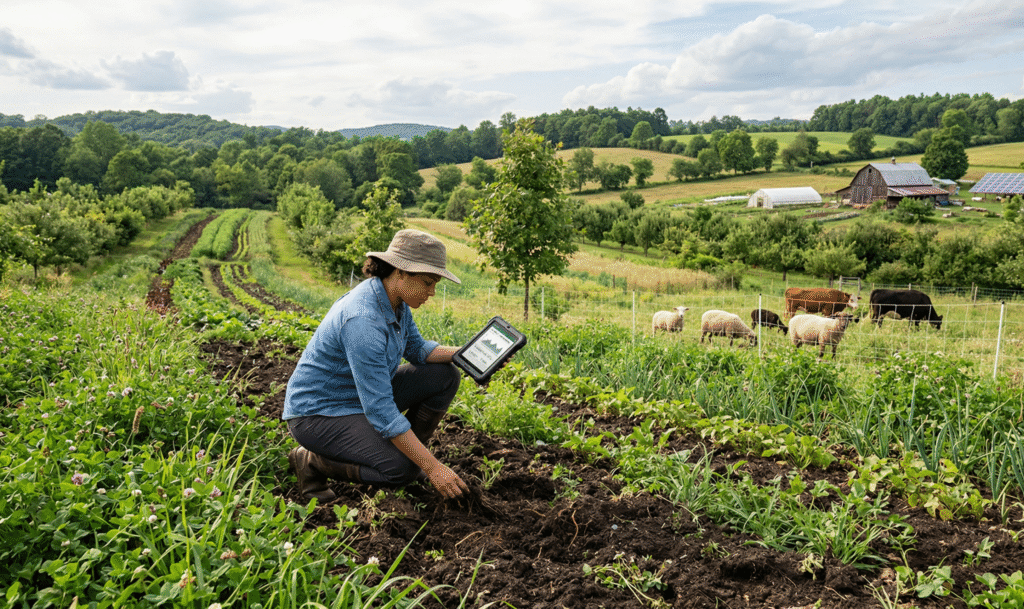
In simple terms, carbon farming uses natural processes to trap carbon while maintaining productive farmland. Practices such as cover cropping, reduced tillage, agroforestry, crop rotation, compost use, and biochar application all contribute to increasing soil carbon storage.
This approach not only supports the environment but also ensures that farms remain productive and sustainable in the long run.
How Carbon Farming Works in Practice
At its core, carbon farming focuses on maintaining healthy and active soil systems. The main principles include keeping soil covered, reducing disturbance, and ensuring plants are growing for longer periods throughout the year.
Plants absorb carbon dioxide from the atmosphere through photosynthesis and convert it into organic material. While some of this carbon is stored in plant structures, a significant portion enters the soil through roots and decomposing matter.
Over time, this process builds soil organic matter, which acts as a natural carbon storage system. Techniques like planting cover crops after harvest, applying mulch, or integrating trees into farmland help extend this carbon capture process.
Livestock management also plays a role. Rotational grazing, where animals are moved between different areas, allows grasslands to recover and store more carbon below the surface.
Why Carbon Farming is Gaining Attention
Farmers are increasingly adopting carbon farming because it offers both environmental and economic benefits. Soil rich in organic matter retains more water, reduces erosion, and supports beneficial microorganisms that improve crop health.
In regions prone to drought, this can lead to more stable yields and reduced dependence on external inputs like fertilizers and irrigation.
From a policy perspective, carbon farming is being included in climate strategies worldwide. Governments and organizations are promoting it as part of nature-based solutions. In some cases, farmers can even earn income through carbon credit programs by demonstrating how much carbon they store.
Challenges and Limitations
Despite its potential, carbon farming is not an instant solution. Building soil carbon takes time, often requiring years of consistent effort. The amount of carbon that can be stored depends on several factors, including soil type, climate, and past land use.
Another challenge is measurement. Accurately calculating how much carbon is being stored on a farm requires proper monitoring systems, which can be complex and costly. Without reliable data, it becomes difficult to create fair and effective incentive programs.
There are also limits to how much carbon soil can store. Once the soil reaches its capacity, the rate of carbon absorption slows down, which raises concerns about long-term scalability.
The Future of Carbon Farming
The future of carbon farming depends on more than just agricultural techniques. It requires collaboration across multiple fields, including science, economics, and policy.
Farmers need access to knowledge, financial support, and practical tools to adopt these practices confidently. For example, transitioning to no-till farming or cover cropping may involve initial costs and risks, which can discourage adoption without proper incentives.
To make carbon farming successful on a larger scale, there must be:
- Better tools for measuring and verifying carbon storage
- Fair payment systems for farmers
- Strong policy support and awareness programs
- Farmer-led innovation and knowledge-sharing networks
When these elements come together, carbon farming has the potential to become a sustainable and inclusive solution for climate change while supporting agricultural communities.
