
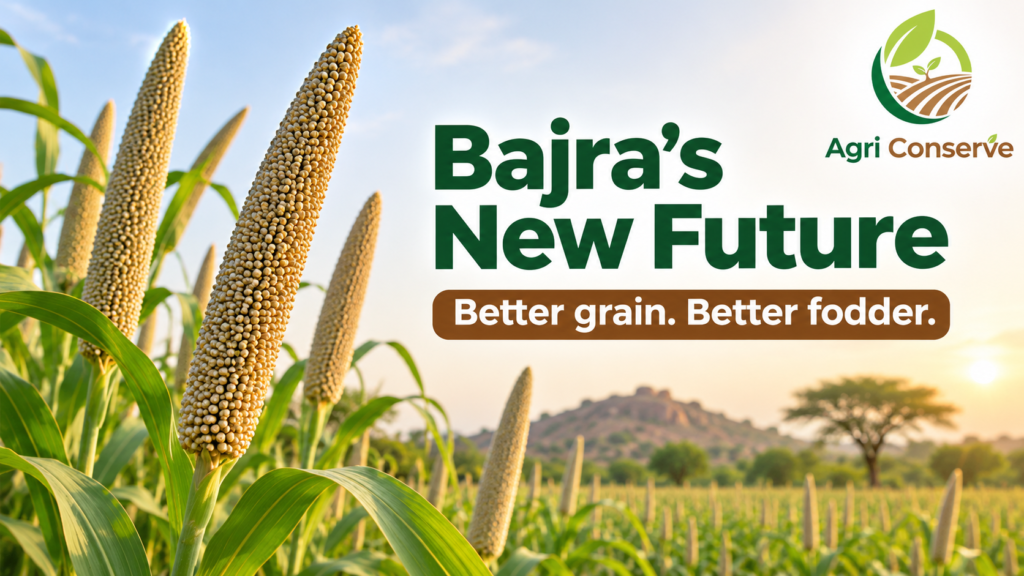

Bajra has been grown in India for thousands of years. It survives where many other crops struggle, particularly in regions with limited rainfall and difficult soil conditions.
But scientists now believe this traditional grain has much more potential than farmers have been able to unlock.
Researchers at the International Crops Research Institute for the Semi-Arid Tropics (ICRISAT) are developing new pearl millet varieties that could provide farmers with two valuable products from the same field: better grain for food and improved fodder for livestock.
Their latest breeding advances, highlighted on October 31, 2026, could open new opportunities for dryland farmers across India and Africa.
A Traditional Crop With a New Advantage
Pearl millet is already known for tolerating high temperatures and water scarcity. In parts of Rajasthan, Gujarat and Haryana, it remains an important crop because farmers cannot always depend on sufficient rainfall.
However, surviving drought is only part of the challenge.
Farmers also need good yields, resistance to diseases and sufficient fodder to feed their animals.
This is where the latest research becomes interesting.
ICRISAT and the Indian Council of Agricultural Research (ICAR) have developed RHB 273, described as the world’s first three-way pearl millet hybrid.
Unlike conventional hybrids that combine two parental lines, this variety brings together three parental lines to combine desirable agricultural characteristics.
The aim is to improve grain productivity while maintaining resilience under challenging growing conditions.
The Results Are Encouraging
RHB 273 was tested across 30 locations in Rajasthan, Gujarat and Haryana between 2022 and 2024.
According to ICRISAT, the hybrid produced an average grain yield of approximately 2,230 kilograms per hectare.
That represented a yield advantage of around 13% to 27% over regional comparison varieties.
Researchers also reported resistance to important pearl millet diseases, including downy mildew, blast and smut.
The hybrid was released earlier in 2026 for India’s low-rainfall A1 agricultural zone, where annual rainfall is typically below 400 millimetres.
These results suggest that improved breeding could help farmers achieve more reliable production in difficult environments.
Why Fodder Matters Just as Much as Grain
One particularly valuable part of the research is its focus on livestock.
In dryland communities, farmers often depend on both crop production and animal husbandry.
Bajra provides grain for food, while its stalks and leaves can serve as livestock fodder.
When rainfall is poor, farmers may struggle to produce enough feed for their animals.
ICRISAT is therefore working to improve not only grain characteristics but also fodder productivity and nutritional quality.
During its recent Pearl Millet Scientists’ Field Day, researchers examined breeding materials with higher protein content, improved forage characteristics and sweet-stalk traits.
Some of these characteristics could eventually make pearl millet useful in additional markets, including livestock feed and biomass production.
For farmers, this could mean generating greater value from the same cultivated land.
Thousands of Plants, One Bigger Goal
ICRISAT’s latest field event brought together around 80 scientists from India, Africa, Japan and other regions.
Researchers examined approximately 16,000 plots of pearl millet breeding material, looking at characteristics such as drought tolerance, disease resistance, maturity, grain quality and fodder value.
The scale of the research shows that crop improvement involves much more than developing one successful hybrid.
Scientists must identify promising genetic material, test it across different environments and determine which characteristics genuinely benefit farmers.
The next challenge is ensuring that improved varieties reach farming communities through reliable seed systems.
Could Bajra Become More Valuable to Farmers?
The research reflects a broader opportunity for traditional crops.
Bajra has often been associated with difficult farming conditions and relatively modest market opportunities.
But better breeding, growing consumer interest in millets and improved livestock-feed markets could strengthen its economic potential.
The success of new hybrids will still depend on seed availability, local performance, input costs and market demand.
Nevertheless, the direction is encouraging.
Instead of replacing traditional crops with entirely different ones, researchers are finding ways to make familiar crops more productive and commercially useful.
For dryland farmers, the future of bajra may not simply be about surviving with less water. It could be about earning more value from every harvest.