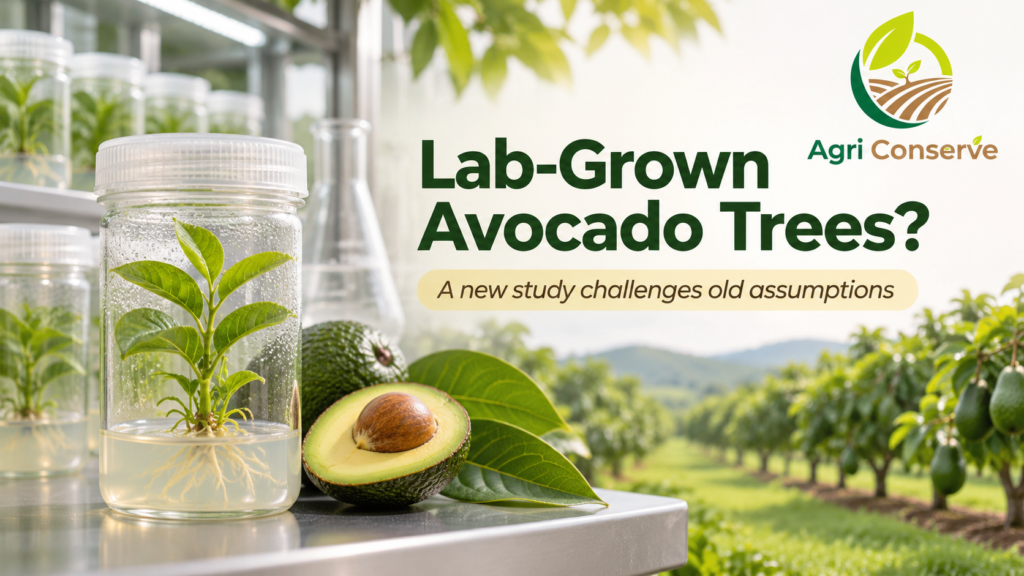

Growing an avocado tree usually begins in a nursery. Growers select planting material, raise young plants and wait for them to become strong enough for an orchard.
But researchers in Australia are developing another way to produce those trees, using small pieces of plant tissue grown under controlled laboratory conditions.
At first, this approach sounds more resource-intensive. Laboratories require electricity, specialised equipment and carefully maintained environments.
Yet a new University of Queensland study has found something surprising.
Producing avocado rootstocks through plant tissue culture can have a similar overall environmental footprint to conventional seedling propagation.
The findings could change how the avocado industry thinks about producing planting material for future orchards.
Why Grow Avocado Plants in a Laboratory?
Avocado growers depend on healthy, reliable rootstocks. These form the root system of the tree and can influence its growth and performance.
Conventional seedling propagation creates genetic variation, meaning individual rootstocks may not all behave the same way.
Tissue culture offers a different approach.
Scientists take carefully selected plant material and multiply it under controlled conditions, producing genetically consistent plants from a chosen parent.
This can help nurseries reproduce desirable rootstocks without depending entirely on seasonal seed availability.
It also offers the possibility of producing larger numbers of plants throughout the year.
For an industry where establishing a productive orchard takes years, reliable planting material can make a significant difference.
The Environmental Question Researchers Wanted to Answer
Laboratory propagation has clear technical advantages, but researchers wanted to know whether those benefits came with a higher environmental cost.
A team from the University of Queensland’s Queensland Alliance for Agriculture and Food Innovation compared tissue-cultured avocado rootstocks with conventionally propagated seedlings.
Rather than looking only at nursery production, they examined the environmental impacts of both methods across a complete avocado production system, including 30 years of orchard operations.
The researchers considered factors such as energy consumption, fertiliser use, irrigation and greenhouse-gas emissions.
Their conclusion challenged the assumption that laboratory-based production is inherently less sustainable.
At the whole-system level, the environmental impacts of the two propagation methods were comparable.
The Biggest Environmental Impact Wasn’t in the Lab
One of the study’s most important findings was that the propagation stage contributed only a small proportion of the overall environmental footprint.
More than 98% of the assessed global warming impact came from the orchard-production stage, regardless of how the rootstocks were produced.
Fertiliser manufacturing and application, along with electricity used for irrigation, were major contributors.
In other words, the environmental impact of growing avocados depended far more on how the orchard operated over its lifetime than on whether the young plants began in a laboratory or a conventional nursery.
This gives growers an important perspective.
Improving irrigation efficiency and fertiliser management may deliver larger environmental benefits than focusing only on how planting material is produced.
Could Tissue Culture Benefit Farmers?
Beyond the environmental findings, tissue culture could offer practical advantages.
Nurseries may be able to multiply selected rootstocks more consistently and supply planting material throughout the year.
For farmers establishing new orchards, this could improve access to rootstocks with desirable characteristics.
The University of Queensland’s wider avocado tissue-culture programme has already demonstrated a pathway from laboratory propagation to nursery production and field trials.
However, researchers caution that more evidence is needed before claiming that tissue-cultured avocado rootstocks consistently produce higher yields or perform better over an orchard’s entire lifespan.
Those benefits still require long-term testing across different environments and genetic varieties.
A Bigger Lesson for Sustainable Agriculture
This research highlights why agricultural technologies should be evaluated across the whole farming system.
A laboratory may consume more electricity than a conventional nursery during propagation, but that does not automatically mean the final agricultural product has a larger environmental footprint.
The full picture includes how long the plants remain productive, how many resources they require and how efficiently the farm operates.
Tissue culture is already an important tool in producing planting material for several agricultural crops.
The Australian findings suggest that its potential should be judged using evidence from the complete production system, rather than assumptions about laboratory energy use alone.
For avocado farmers, the research offers an encouraging direction, although the technology’s economic and agronomic benefits will still need further validation.
The future of sustainable fruit farming may not depend on choosing between laboratories and traditional nurseries. It may depend on using better planting material while making the entire orchard more efficient.